The Data Garbage Trap: Overcoming Structural Ingestion Latency inside Industrial Analytics Layers
It is the ultimate buzzkill for enterprise innovation. A forward-thinking CIO or CDO brings a high-value AI initiative to the boardroom—one designed to automate predictive replenishment or eliminate costly production disruptions—only to be told: "We can't do that yet. Our data is too dirty." The engineering brakes get slammed on. The budget is instantly redirected into a massive, multi-year static data scrubbing project. Teams spend months manually reconciling mismatched naming conventions, deduplicating vendor tables, and cleaning up historical records across legacy systems.
Then comes the real tragedy: by the time the data lake is finally "clean," the market has shifted. New products have launched, customer habits have evolved, and the underlying operational environment has drifted. You are left with a pristine, beautifully polished record of the past—but zero actual business momentum. **Traditional data scrubbing initiatives stall 60% of enterprise analytics projects** before they ever deploy a single line of predictive logic. It is a slow, capital-intensive trap that treats the data lake like a museum instead of an active, living ecosystem.
Stop Cleaning the Past. Streamline the Present.
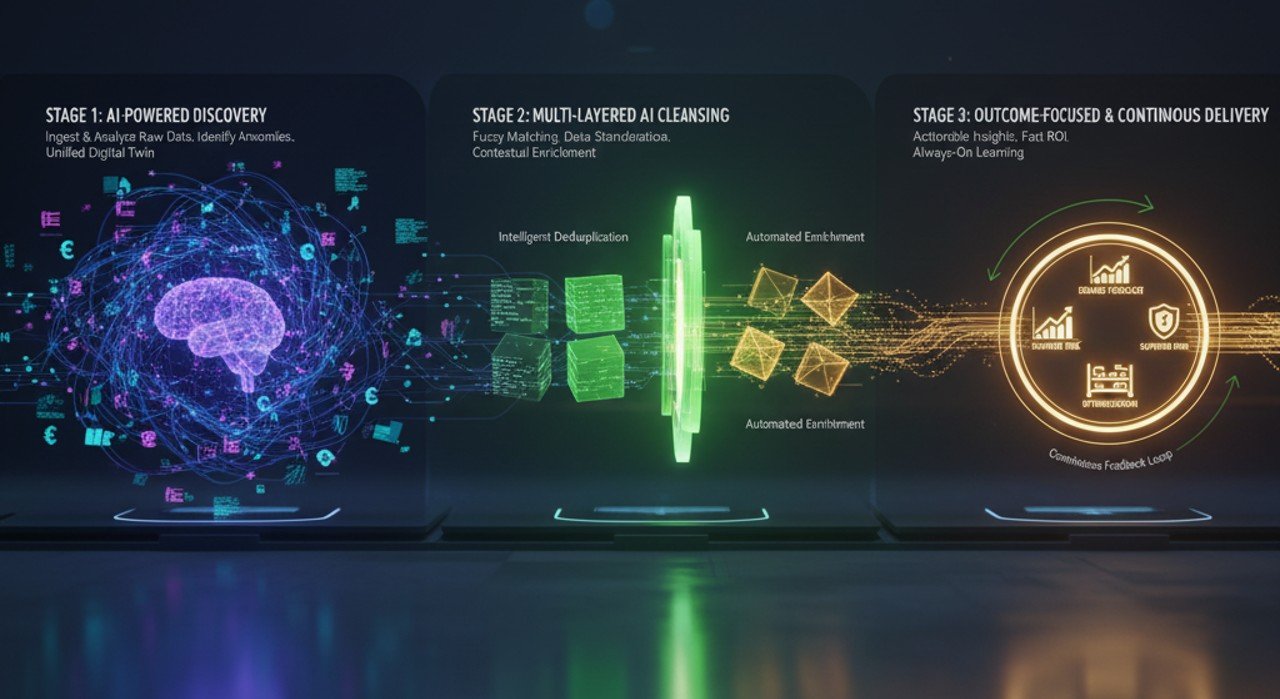
There is a much smarter architectural path. Instead of spending millions attempting to force historical databases into perfect alignment, advanced platforms apply dynamic intelligence directly at the point of ingestion. xChangeFlow creates a non-invasive semantic layer that sits above your existing software. When inconsistent, raw data streams try to break your workflows, our engine dynamically standardizes and maps them in flight. Your central database schemas stay exactly as they are—saving your engineering sanity—while your AI models receive high-fidelity, actionable data streams in real time.
By overlaying xChangeFlow’s ingestion-time orchestration layer, a fast-scaling industrial supplier bypassed a slated 12-month data-scrubbing project entirely. Instead of rewriting legacy databases, they synchronized real-time transaction tracking across five conflicting ERP and WMS architectures. Within an aggressive **60-day operational window**, the system drove a **35% reduction in forecasting anomalies** and clamped down on inventory stockouts by 30%—proving that you can unlock massive business yields without fixing every broken historical data row.
The market winners are not the organizations waiting for the myth of a perfect data lake to come true. They are the ones operationalizing the live signals they have today to protect margins and out-ship their competitors.
Let’s stop letting messy historical tables paralyze your execution. Let’s map your existing technology nodes, isolate cross-system validation errors, and engineer an agile ingestion pipeline that feeds your predictive analytics maps at machine speed—without a single day of platform downtime.
